So Directors Aren't 'Working People'? Your Personal Liability Begs to Differ
Bad news, directors: you've been reclassified
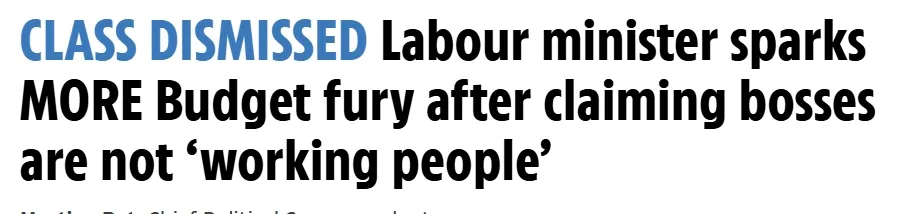
If you run a business and spent the weekend feeling slightly put out, you're not alone. On Sunday, Treasury minister Emma Reynolds told GB News that, in her view, employers aren't working people — "they are companies".
That will come as news to every director who opened up at 7am, ran payroll on a Sunday night and took a client call from the side of a kids' football pitch. Apparently none of that was work. It was just… being a company.
We'd like to offer a second opinion. Not on the politics — we'll leave that to the comment sections — but on a far more practical point. The Treasury may not see you as a person, but plenty of others do: HMRC, the Health and Safety Executive, liquidators, regulators, unhappy investors and the occasional ex-employee with a good solicitor. When they come knocking, they aren't looking for "the company". They're looking for you.
How we got here
Chancellor John Healey's first Budget added an extra 2p of income tax on rental and savings income from April 2027. Interviewer Camilla Tominey put it to Ms Reynolds that this broke Labour's pledge not to raise taxes on working people — landlords and savers work too, after all.
The minister's answer was that the pledge covered taxes on employees, and that employers are a different category. When Tominey asked whether employing a cleaner meant she was no longer a working person, Ms Reynolds said the difference was that Tominey was probably an employee of her own company.
The reaction was swift. Reform UK's Robert Jenrick, shadow business minister Bradley Thomas and shadow defence secretary James Cartlidge all piled in, with Thomas pointing to the electrician who takes on an apprentice and the florist who gives a teenager weekend shifts. By Monday, science minister Chris McDonald was on LBC saying that yes, employers are working people, and suggesting his colleague had been misrepresented.
So, depending on which minister you ask before 9am, you are either a working person or a company. Schrödinger's director, if you like.
You may be "a company". Your liability isn't.
Here's the bit limited liability doesn't put on the brochure: it protects shareholders' money, not directors' decisions. Under the Companies Act 2006, directors owe personal duties — to act within their powers, promote the success of the company, use reasonable care, skill and diligence, and avoid conflicts of interest. Get it wrong, and the claim can land on your doormat, not the company's.
People who can pursue a director personally include:
Liquidators and administrators — for example, wrongful trading claims if a business kept trading when insolvency was unavoidable.
HMRC — which in certain circumstances can make directors personally liable for unpaid tax and National Insurance.
The HSE and other regulators — investigations, interviews under caution and prosecutions after a serious incident.
Employees — tribunal claims that name directors individually.
Shareholders, investors, lenders and customers — allegations of mismanagement or misrepresentation.
The Insolvency Service — director disqualification proceedings.
Funny how "not a working person" still comes with a personal legal address.
And before anyone says "that's a big-company problem" — it's often the opposite. In an owner-managed SME, the directors are the decision-makers, the finance team and the HR department. Add a tougher tax environment and tighter cash flow, and the exposure is very real.
Enter Directors' & Officers' insurance — the one policy that treats you as a person
D&O insurance protects the individuals running a business, not just the business itself. Depending on the policy, it can pay for:
Legal defence costs — often the biggest bill, and payable whether or not you're ultimately found at fault.
Damages and settlements where you're held personally liable.
Investigation costs — representation when a regulator or authority wants to interview you.
Useful extras — such as crisis PR, cover for retired directors, and protection for your estate or spouse if a claim follows you.
It matters most when the company can't step in. If the business is insolvent or simply not allowed to indemnify you, D&O can be the only thing between a claim and your personal assets.
Scenario | What happens | How D&O can help |
|---|---|---|
Business enters insolvency | Liquidator alleges directors traded too long | Defence costs and any damages awarded |
Serious accident on site | HSE interviews directors under caution | Legal representation for the investigation |
Ex-employee claims unfair treatment | Tribunal claim names a director personally | Defence costs and settlement, subject to wording |
Investor unhappy with a deal | Alleges they were misled by the board | Defence costs and damages |
The small print still matters. D&O won't cover deliberate fraud or dishonesty, fines and penalties that can't legally be insured, or problems you already knew about before the policy started. Limits, extensions and exclusions vary a lot between insurers — which is exactly why it pays to have a broker read the wording for you.
Working person or not, we've got you covered
Whatever Westminster decides you are this week, Motum Insurance Services sees you as what you actually are: the person carrying the can. We're an independent commercial broker based in Kettering, working with SME owners and directors across Northamptonshire and beyond.
Many business owners assume D&O is already in their commercial package. Often it isn't — or the limit is far too low for the risks they face. We'll:
Check what you've currently got, and where the gaps are.
Take your risk to the market and find the right cover at the right price.
Explain the wording in plain English — no jargon, no surprises at claim time.
Book a free D&O review with the Motum team 0345 034 4542.
You might not be a "working person" to the Treasury. But to us, you're a client — and that's better.
